
Around the 1980s, scientists began uncovering a mysterious structure within our universe—one that conflicts with our fundamental understanding of cosmology. We started noticing that galaxies clump together in unfathomably large groups called superclusters, arranged in a web-like pattern. These superclusters contain tens of thousands to potentially billions of galaxies, and each of those galaxies is home to hundreds of millions to billions of stars. On average, each star hosts around two planets. This many celestial objects clumped into a single structure should be incomprehensibly rare, yet these superclusters make up the large-scale structure of the universe, creating what we call the Cosmic Web.
A side effect of this Cosmic Web is that it leaves massive holes in the universe. There are regions where there is literal nothingness for 250 million light-years (1,469,656,343,000,000,000,000 miles), and while space is mostly empty, that much nothingness in one place is strange, even by the universe's standards. The birth and expansion of the universe should have prevented structures like this from forming, yet this is how space is laid out.
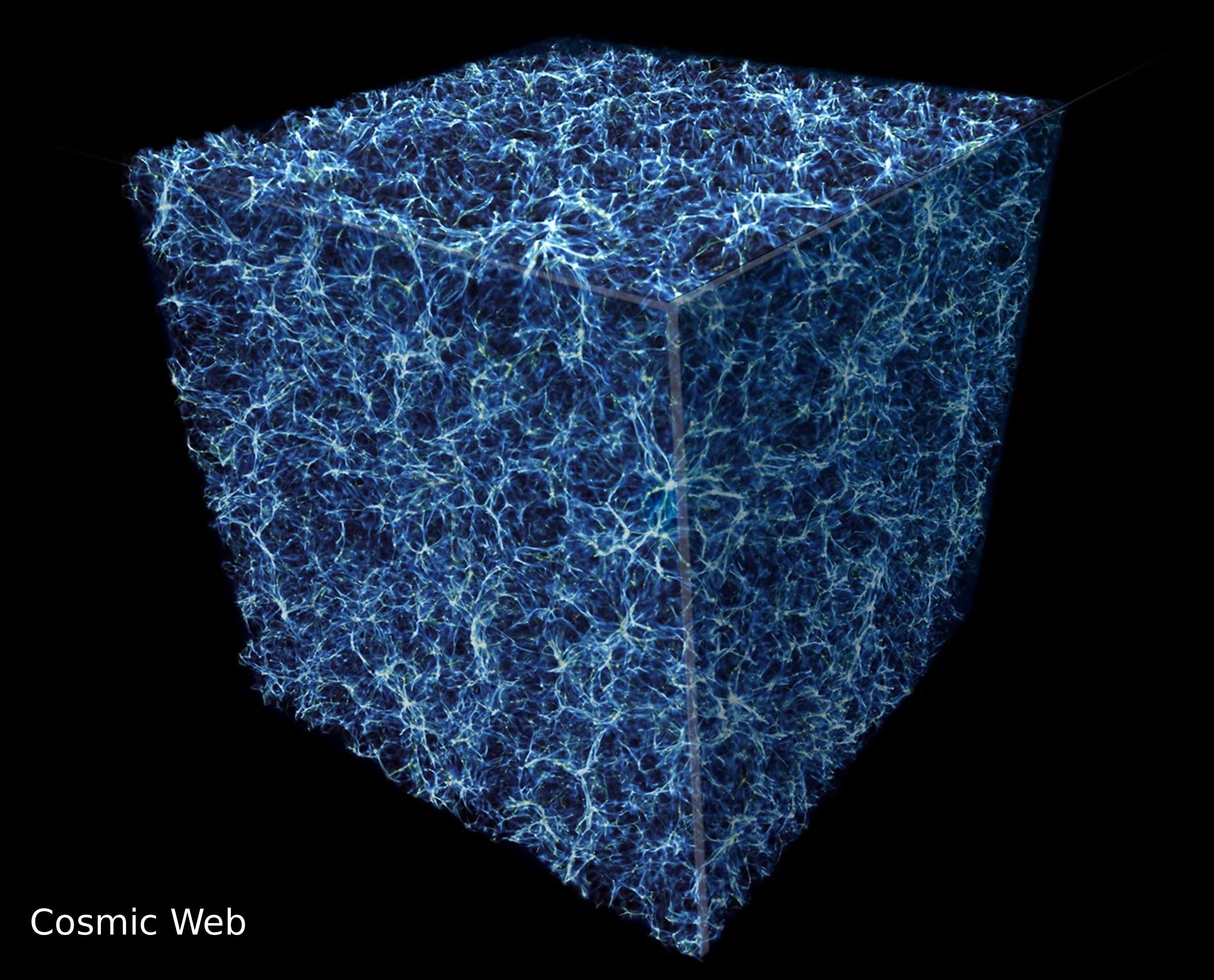
So what gives? Why is the universe a web, even though it shouldn't be physically possible? The question does have an answer, and it's a surprisingly satisfying one. The mystery behind this phenomenon is none other than dark matter.
We have no idea what dark matter actually is, but we do know one of its key properties: like any other type of matter in the cosmos, it has mass. How big an individual piece of dark matter might be, we don't know, but we can measure its mass on large scales. What does this have to do with the Cosmic Web? Well, I'm glad you asked. Since dark matter has mass, it also has a gravitational pull. That pull is what keeps galaxies densely packed. Without it, galaxies would spread out and fill in the empty gaps of space.
This property of dark matter acts as a gravitational scaffold for everything in the universe. Think of it as cosmic super glue, forming the very fibers of existence.

Dark matter isn't just holding these superclusters together; it's also lurking in the outskirts of our own galaxy. Why is it there? We don't know—but the top scientists in the world are working on it right now. Until then, stay curious and extragalactic.